
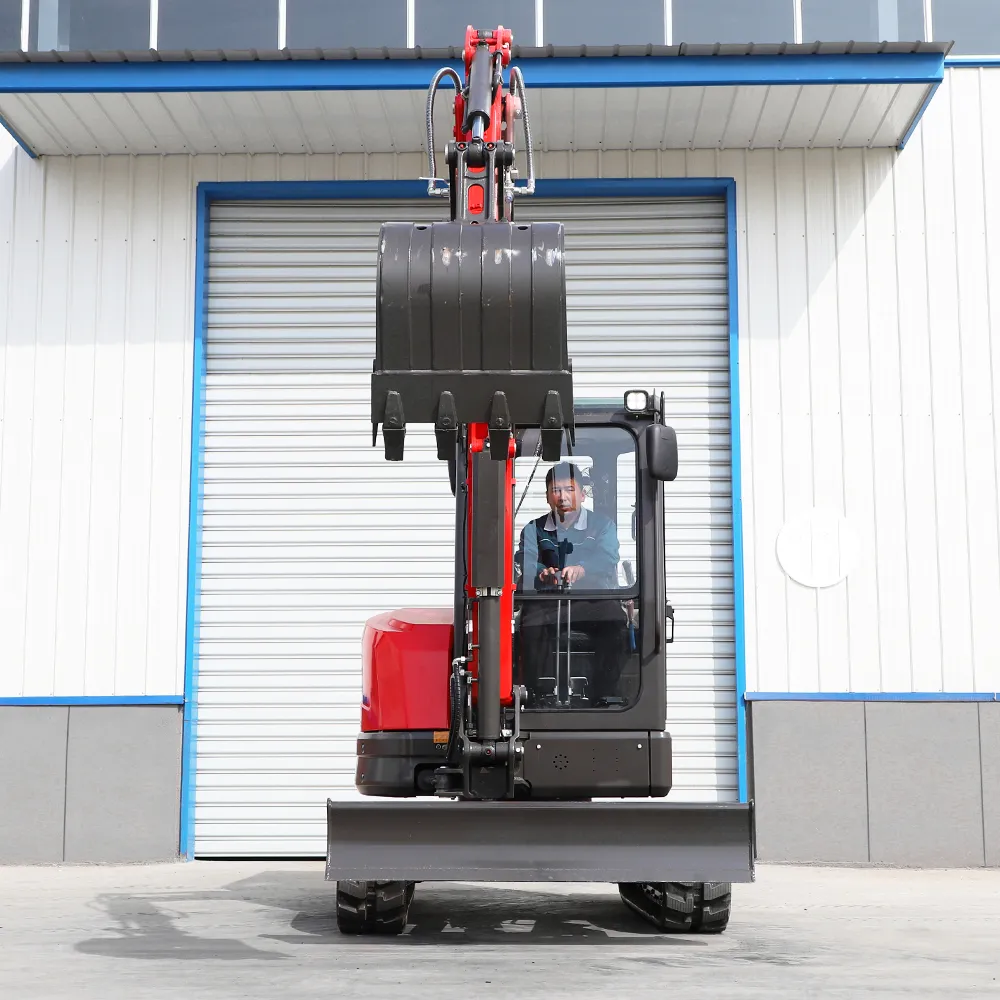
Executing localized infrastructure upgrades inside historical European city centers, high-density residential subdivisions, and modern telecommunications corridors presents a unique set of geometric and mechanical constraints. Standard full-sized earthmovers are physically barred from entering these highly restricted operational zones due to their massive structural footprints, heavy tail swings, and wide transit requirements. When the assignment demands cutting clean, structurally sound deep utility channels directly alongside ancient brick foundations or beneath low-hanging municipal fiber-optic lines, contractors cannot rely on brute force alone. Instead, the global civil engineering sector increasingly turns toward a highly specialized, fluid-driven compact hydraulic bagger to navigate these challenging spatial configurations. Optimizing macro-level production indicators within a micro-level working environment requires an advanced combination of telescopic structural configurations, localized fluid-flow dynamics, and adaptive attachment integration. When properly calibrated, this versatile machinery allows independent contractors and municipal utility fleets to move hundreds of cubic meters of compacted subsoil without causing collateral disruption to surrounding residential or commercial frameworks.
Navigating extreme spatial barriers with adjustable track frames and zero counterweight overhang
The first critical obstacle encountered during an urban utilities project is the physical entrance gate or narrow alleyway that leads directly into the digging site. Traditional earthmoving equipment often remains completely stranded on the street grid because fixed, wide undercarriage assemblies cannot pass through standard two-meter courtyard entrances. This specific spatial bottleneck is precisely why a high-performance compact bagger engineered with a hydraulically retractable undercarriage has become a mandatory asset for municipal contracting bids.
By utilizing an integrated auxiliary fluid circuit, the operator can temporarily retract the machine's crawlers to a narrow footprint, allowing it to glide effortlessly through tight side pathways and garden gates. Once the equipment safely occupies the active excavation zone, the operator extends the undercarriage tracks back out to their maximum width, establishing an incredibly stable, broad foundation capable of resisting intense lateral tipping leverage. Furthermore, when this flexible tracking layout is paired with zero tail swing cab geometry, the upper house can rotate smoothly throughout its entire three-hundred-and-sixty-degree arc without the risk of the rear counterweight colliding with adjacent structural brick walls, delicate wooden fencing, or active civilian pedestrian lanes.
Balancing high-pressure variable flow pumps with smooth pilot joystick linearity
Cutting a continuous, plumb line for a fiber-optic conduit or a high-pressure natural gas pipe requires an extraordinary degree of micro-hydraulic refinement. In basic engineering setups that rely on low-cost fixed gear pumps, the delivery of hydraulic fluid is entirely dependent on engine RPM, forcing the operator to constantly rev the machine to achieve adequate breakout force. This outdated fluid layout causes the machine to experience violent, jerky boom reactions, resulting in over-excavation, cave-ins, and the accidental fracturing of adjacent, uncharted clay water mains.
Modern urban engineering demands that a reliable compact bagger utilize an advanced variable-displacement axial piston pump system governed by load-sensing hydraulic control circuits. This high-end fluid configuration continuously monitors real-time digging resistance at the bucket cutting edge and instantly recalculates the required oil volume delivery. Whether the operator is slicing through thick, root-infused topsoil or delicately scraping around a pre-existing concrete electrical vault, the hydraulic system delivers predictable, linear joystick control. This ultra-smooth fluid response eliminates mechanical jerking, minimizes operator physical fatigue over extended ten-hour shifts, and ensures the excavated trench walls remain perfectly vertical and stable for the immediate placement of shoring boxes.
Protecting municipal property using continuous rubber tracking matrices
Moving heavy construction equipment across high-end suburban lawns, historical cobblestone plazas, and structural concrete driveways usually results in extensive, costly surface destruction. For modern contracting enterprises, the financial burden of replacing cracked brick pavers or repairing deeply gouged asphalt can easily destroy the net profit margins of an entire utility contract. Therefore, mitigating ground surface disturbance is just as critical as the speed of the earthmoving process itself.
The implementation of premium, steel-cored continuous rubber tracks on the compact hydraulic bagger provides an elegant solution to these surface preservation challenges. The flexible rubber track compounds distribute the operational operating weight of the machine across a significantly wider surface area, lowering the overall ground pressure to a minor fraction of a traditional wheeled vehicle. This low ground bearing pressure prevents the tracks from sinking into wet topsoil or fracturing underlying subbase gravel. Additionally, the soft rubber contact layer allows the machine to cross finished stone sidewalks and decorative concrete patios without leaving permanent black scars, eliminating post-project restoration expenses and securing immediate client approval.
Maximizing multi-tool utility through mechanical quick coupler interfaces
A professional trenching operation is rarely a single-stage task; it is a fluid, multi-phase engineering process that adapts continuously to changing geological strata and diverse infrastructural specifications. The initial phases of a long-distance drainage project require a narrow, deep-profile trenching bucket to minimize the volume of excavated earth that must be hauled away. However, if the machine strikes an unexpected subterranean ledge of solid limestone or a highly compacted layer of ancient road bedding, a standard digging bucket will stall, causing severe shockwaves to reverberate up the boom arm.
To maintain continuous uptime under these unpredictable conditions, fleet managers ensure their compact hydraulic bagger is outfitted with a heavy-duty mechanical or hydraulic quick-coupler block. This system allows the operator to swap specialized attachments in less than two minutes without leaving the safety of the cabin. When hard geological barriers are encountered, the digging bucket is quickly replaced with a high-impact hydraulic breaker to fracture the stone stratum. Once the obstruction is cleared, the operator can transition to an auxiliary compaction wheel to pack down the backfill dirt, turning the compact bagger into a comprehensive, self-contained utility system that manages every stage of the pipeline installation cycle.
Supporting commercial asset longevity through robust global supply chain engineering
The true commercial viability of any compact construction asset is measured long after the initial purchasing invoice is settled. For machinery distribution networks, equipment rental hubs, and independent municipal contractors, long-term profitability is governed entirely by daily machine availability, minimal fuel consumption, and the immediate availability of replacement service parts. If a machine relies on highly obscure, non-standardized components, a single damaged hydraulic hose or a broken electrical sensor can leave an expensive asset completely paralyzed for weeks while cross-border shipping is arranged.
This unyielding mechanical durability and commitment to global engineering compliance are exactly what define the compact equipment lines manufactured by Infront. Highly respected across the international engineering sector for integrating advanced robotic undercarriage welding, high-frequency stress diagnostics, and meticulous hydraulic flow calibrations, Infront constructs compact bagger configurations engineered to thrive under demanding, multi-shift commercial operating cycles. By utilizing globally recognized powertrain brands like Kubota and Yanmar, and ensuring that international parts interchangeability is standard across every single technical blueprint, Infront provides global distribution networks and professional contractors with highly resilient assets. Investing in heavy machinery built with this level of manufacturing precision guarantees that your compact bagger remains continuously active on the job site, fully supported by an efficient, highly responsive global supply chain that keeps unexpected mechanical downtime to an absolute minimum.
Table of Contents
- Navigating extreme spatial barriers with adjustable track frames and zero counterweight overhang
- Balancing high-pressure variable flow pumps with smooth pilot joystick linearity
- Protecting municipal property using continuous rubber tracking matrices
- Maximizing multi-tool utility through mechanical quick coupler interfaces
- Supporting commercial asset longevity through robust global supply chain engineering