
Hard Rock Extraction Realities and Stalled Quarry Production
Open-pit granite operations punish standard construction machinery. At a medium-scale aggregate and dimensional stone quarry operating across steep, narrow benches, daily rock loading ground to a near halt. Blast patterns in high-quartz granite frequently left oversized, interlocked slabs wedged tight against the quarry toe. The site operations director initially assigned two standard 36-ton commercial excavators to load 40-ton articulated haul trucks. Within four months, both machines suffered recurring structural and thermal failures that starved the primary jaw crusher of feed material.
Haul trucks queued idle at the loading bay while operators struggled to pry loose tightly packed rock piles. Whenever an off-the-shelf excavtor attempted to break out unyielding toe rock, relief valves screamed at maximum pressure without generating sufficient bucket tip penetration. Unscheduled downtime climbed past 25 percent of scheduled shift hours, driving cost-per-ton metrics to unsustainable levels. Resolving this extraction bottleneck demanded stepping away from mass-produced dealer inventory and commissioning a custom engineered excavtor built specifically for high-shock granite excavation.
Why Mass-Produced Earthmovers Fail in High-Abrasion Rock Faces
Standard construction fleets are built around compromise. Manufacturers design baseline tracked machines to handle highway grading, clay trenching, and general site prep at a competitive factory price. Drop that same standard excavtor into an unyielding hard-rock pit, and mechanical weak points surface fast. During heavy prying cycles, torsional stress travels straight from the bucket teeth into the stick weldments and boom foot castings. On the quarry's original machines, ultrasonic inspections revealed micro-cracks spreading along the heat-affected zones of the lower boom baffle plates after just 1,100 service hours.
Heat buildup inside the hydraulic circuit created an equally stubborn failure mode. Pulling against stalled rock piles forces variable-displacement piston pumps to stay at maximum swashplate angle while high-pressure oil dumps across relief valves. Standard cooling packages, where the hydraulic oil cooler sits stacked directly in front of the engine water radiator, choked on fine silica dust. Once hydraulic oil temperatures pushed past 88 degrees Celsius, oil viscosity dropped sharply. Internal pump leakage spiked, main control valve spools bound up from thermal expansion, and swing torque faded by nearly a third during afternoon shifts. Buying a heavier 50-ton standard excavtor was ruled out immediately; the bench width simply could not accommodate a wider tail-swing radius, and larger standard units still carried the same vulnerable cooling layout and standard-duty boom geometry.
Structural Reconfiguration and Heavy-Duty Boom Kinematics
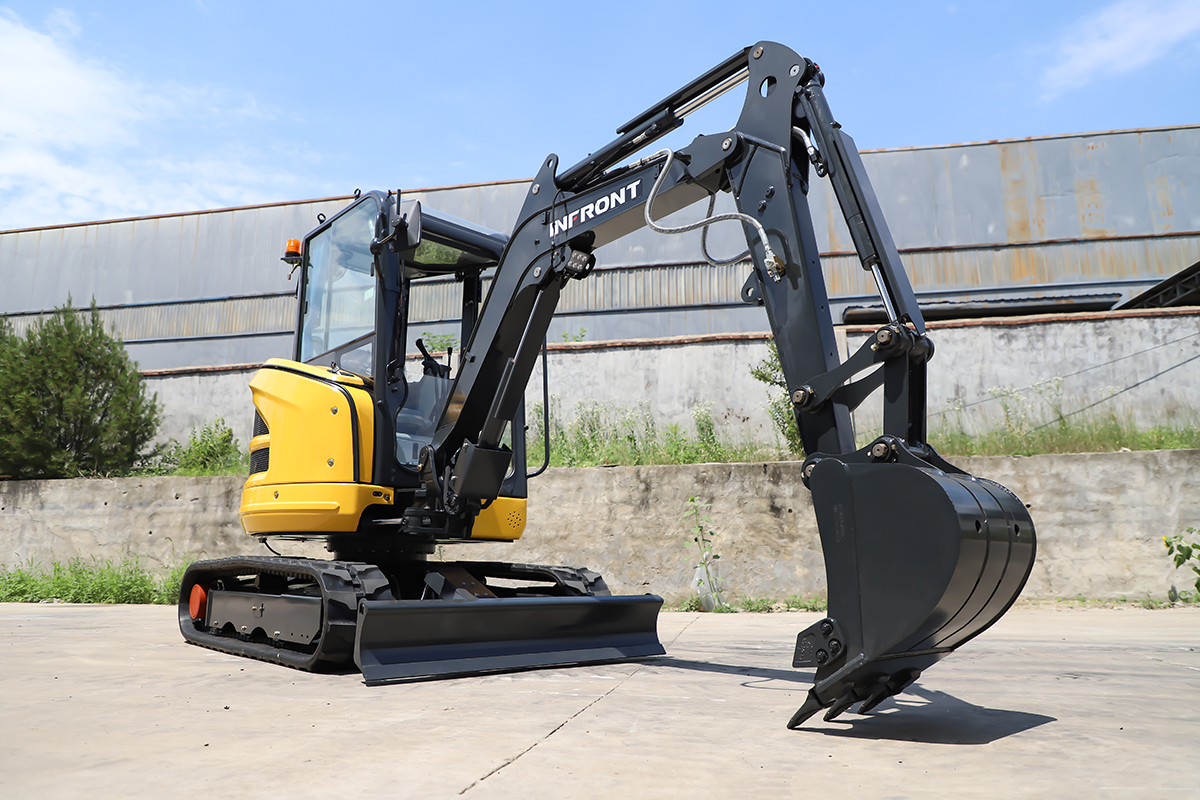
Eliminating the mechanical failures required rebuilding the machine's working front and lower chassis from the ground up. Quarry engineers partnered with Shandong Infront Machinery to specify a purpose-built excavtor tailored to the pit's spatial and geological limits. Instead of lengthening the reach, engineers shortened the front stick by 350 millimeters and relocated the bucket cylinder pivot pin. This altered kinematic ratio traded away unnecessary top-end dumping height in exchange for a 22 percent jump in mechanical bucket curling force and arm crowd power right at ground level.
Every load-bearing section of the custom engineered excavtor underwent finite element stress mapping prior to steel cutting. Fabrication teams replaced standard structural steel with high-tensile Q460 and NM400 wear-resistant alloy plates across the boom box section. Internal full-length torsion baffles were welded inside the boom using automated submerged-arc processes, followed by post-weld thermal stress relief to prevent weld toe cracking. All front linkage pivot pins were upgraded to 42CrMo induction-hardened alloy steel featuring deep spiral grease grooves and triple-lip polyurethane dust seals. Down below, the custom excavtor received a heavily gusseted X-frame carbody, full-length rock guards bolted along the lower track rollers, and heavy-duty double-grouser track shoes that resisted bending when pivoting over jagged granite shards.

Closed-Loop Hydraulic Tuning and Independent Thermal Control
Hardened steel alone cannot move rock if the hydraulic heart starves for flow or cooks its own fluid. To match the reinforced linkage, the engineering team recalibrated the main hydraulic system of the custom excavtor around high-pressure, low-loss fluid delivery. Twin axial-piston main pumps were paired with an electronic positive-flow control architecture rather than a conventional negative-flow orifice setup. By trimming pilot pressure dead-bands inside the main control valve spools, the excavtor delivered instantaneous hydraulic lock-up at the bucket tip without wasting engine horsepower through bypass throttling.
Thermal stability received a complete overhaul. Engineers separated the hydraulic oil cooler from the engine radiator stack, mounting it in a dedicated side bay cooled by an independent, hydraulically driven axial fan. Controlled by proportional thermostatic sensors in the return manifold, the fan automatically reverses blade pitch every twenty minutes for fifteen seconds, blasting trapped granite dust right out of the aluminum cooling fins. The return circuit of the custom engineered excavtor was also fitted with 10-micron high-beta glass fiber elements and high-gauss magnetic trap rods inside the hydraulic tank, catching microscopic metallic wear particles before they could score the brass slippers inside the main piston pumps.
Quarry Bench Performance and Measurable Cycle Time Drops
Once delivered and commissioned at the quarry face, the modified excavtor altered the loading rhythm on day one. Where the previous machines required two or three scraping passes to fill a bucket in tightly wedged rock, the shortened heavy-duty stick and boosted hydraulic relief settings allowed operators to slice through the muck pile and achieve a 105 percent heaped bucket fill factor in a single smooth pass. Track slippage during crowding vanished thanks to the heavier counterweight balance and aggressive double-grouser track grip.
Stopwatches told the clearest story for site management. Average dig-swing-dump-return cycle times dropped from a sluggish 29.5 seconds down to 21.8 seconds—a 26 percent speed improvement per pass. A 40-ton haul truck that previously took five minutes to load was now pulling away from the bench in three minutes and twenty seconds. Throughout grueling ten-hour summer shifts with ambient pit temperatures hovering near 38 degrees Celsius, the independent fan circuit held hydraulic oil temperatures steady between 58 and 65 degrees Celsius. Power fading disappeared completely, and the custom excavtor kept the primary jaw crusher running at 96 percent hopper capacity without adding a single extra operator to the payroll.
Twelve-Month Wear Inspections and Capital Payback Metrics
True proof of any heavy equipment investment shows up in the maintenance ledger after a full year of punishment. At the 2,500-hour inspection mark, maintenance technicians conducted dye-penetrant and ultrasonic testing across every weld seam on the custom engineered excavtor. Zero structural fissures were found on the boom foot, stick boss, or carbody X-frame. Pin-and-bushing clearance on the bucket linkage measured well within factory tolerances, slashing greasing pin replacement costs by nearly 80 percent compared to the retired standard fleet.
The rock bucket itself—outfitted with replaceable shroud protectors, heel plates, and chromium-carbide wear strips—extended ground-engaging tooth life from 130 hours to 310 operating hours. Overall mechanical availability of the custom excavtor climbed from the quarry's historical 73 percent average to an impressive 94.2 percent. Furthermore, because the positive-flow hydraulic calibration eliminated relief-valve stalling, fuel burn dropped by 4.5 liters per operating hour despite moving significantly more rock. When finance managers balanced the 18 percent upfront premium paid for custom factory engineering against the surging aggregate output and avoided repair bills, the customized excavtor achieved full capital payback of its customization cost in less than five months of operation.
Practical Sourcing Guidelines for Heavy Extractive Operations
Fleet procurement managers often fall into the trap of comparing machines strictly by operating weight and brochure horsepower. In severe mining and quarry environments, brochure specs rarely reflect how a machine survives shock loading, silica dust ingestion, and continuous high-pressure relief cycles. Buying a standard commercial excavtor for severe rock extraction simply shifts capital expense into painful, ongoing maintenance bills and lost crusher tonnage.
Working directly with an adaptable manufacturer capable of altering boom geometry, upgrading steel metallurgy, and isolating thermal cooling circuits turns equipment procurement into a genuine operational advantage. Before signing off on the next fleet replacement, site engineers should audit their actual bench dimensions, rock compressive strength, and hydraulic thermal loads—then specify a custom engineered excavtor built to conquer those exact site conditions from the first bucket pass.
Table of Contents
- Hard Rock Extraction Realities and Stalled Quarry Production
- Why Mass-Produced Earthmovers Fail in High-Abrasion Rock Faces
- Structural Reconfiguration and Heavy-Duty Boom Kinematics
- Closed-Loop Hydraulic Tuning and Independent Thermal Control
- Quarry Bench Performance and Measurable Cycle Time Drops
- Twelve-Month Wear Inspections and Capital Payback Metrics
- Practical Sourcing Guidelines for Heavy Extractive Operations